

For UAE business owners, the statutory audit has transitioned from a “compliance checkbox” to a high-stakes financial health check. With the Federal Tax Authority (FTA) now fully enforcing Corporate Tax penalties and tightened Free Zone regulations, being “audit-ready” is the only way to safeguard your trade license and tax standing.
This guide breaks down exactly how to prepare for statutory audit successfully in 2026.
1. Who is Legally Required to Audit in 2026?
Under Ministerial Decision No. 84 of 2025, the requirements for audited financial statements are no longer ambiguous. Your business must undergo a statutory audit if it falls into these categories:
- Revenue Threshold: Any Taxable Person with an annual revenue exceeding AED 50,000,000.
- Qualifying Free Zone Persons (QFZP): To maintain the 0% Corporate Tax rate, an audit is mandatory regardless of revenue.
- Mainland LLCs & Joint Stock Companies: Per the UAE Commercial Companies Law, most mainland entities must appoint a licensed auditor.
- Zone-Specific Mandates: Authorities such as DMCC, DIFC, and JAFZA require audited financials for annual license renewals.
Expert Insight: Even if your revenue is below AED 3M and you qualify for Small Business Relief (SBR), your Free Zone authority or your bank may still mandate an audit. Always check your specific Licensing Authority’s bylaws.
2. The Statutory Audit Lifecycle
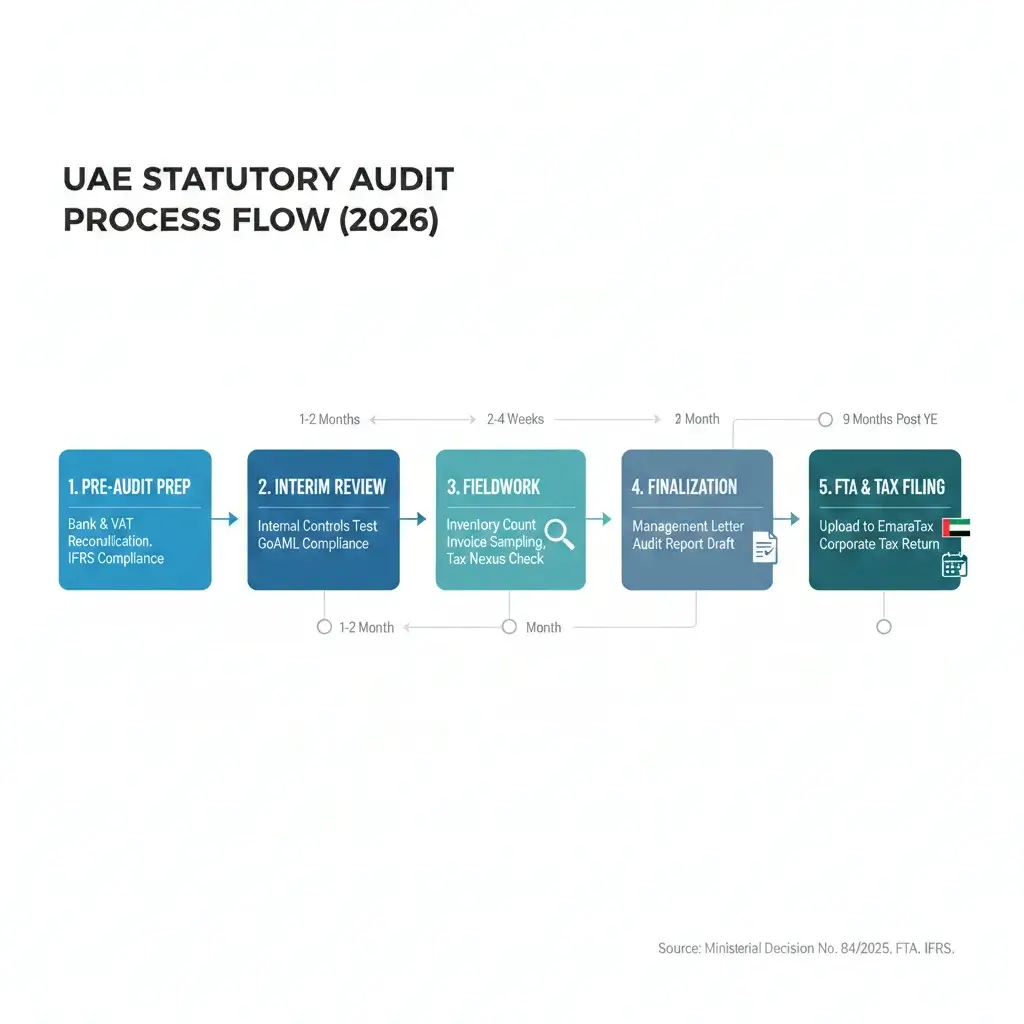
A successful audit is a year-round process. Waiting until January to organize your books is the most common cause of “Qualified Opinions” (negative audit results).
| Phase | Key Action Item | Critical Deadline |
| Preparation | Reconcile VAT returns vs. Revenue in Ledger. | Before Year-End |
| Interim Review | Auditors test internal controls and “GoAML” compliance. | Q3 or Q4 |
| Fieldwork | Physical stock-take and sampling of tax invoices. | Jan – March |
| Finalization | Management Representation Letter signed. | Within 4 months of YE |
| Tax Filing | Audited accounts uploaded to EmaraTax portal. | Within 9 months of YE |
3. Advanced Preparation Checklist: Beyond the Basics
To rank as a top-tier business, your documentation must go beyond simple receipts. In 2026, auditors are focusing heavily on Tax Nexus and Transfer Pricing.
A. The “Trial Balance” Integrity
- Ensure the Trial Balance (TB) matches the General Ledger perfectly.
- IFRS Standards: Ensure financials are prepared according to the latest International Financial Reporting Standards.
B. Corporate Tax & VAT Nexus
- VAT Reconciliation: Every dirham of revenue in your audit must be traceable to your filed VAT returns. Discrepancies often trigger FTA audits.
- Corporate Tax Registration: Provide your Tax Registration Number (TRN) and proof of registration.
C. Related Party Transactions (Transfer Pricing)
- If you trade with sister companies or shareholders, you must have a Transfer Pricing Disclosure ready. Auditors will check if these transactions are at “arm’s length” (market rates).
D. Compliance & Legal Folders
- WPS Reports: Provide proof that 100% of staff salaries are paid through the Wage Protection System.
- UBO Registry: Provide a copy of your Ultimate Beneficial Owner declaration.
- End-of-Service Benefits: Ensure the gratuity provision is calculated per the UAE Labour Law.
4. The “Experience” Factor: Realities of the 2026 Audit
Based on our experience assisting hundreds of firms in Dubai and Abu Dhabi, here are the “hidden” hurdles that delay audits:
- The “Sampling” Trap: Auditors will pick random transactions. If you cannot produce a valid Tax Invoice for a transaction from 11 months ago within 24 hours, it signals weak internal controls.
- Physical Inventory: In sectors like retail or manufacturing, auditors must witness the year-end count. If you perform your count without inviting the auditor, they may “qualify” your report, which banks will reject.
- Digital Accessibility: Paper is dead. Ensure all contracts, bank statements, and invoices are in a searchable PDF format on a secure cloud drive (e.g., SharePoint or Zoho Docs).
5. Strategic Benefits of a “Clean” Audit
An audit isn’t just a cost; it’s an asset. A clean report from a reputable UAE-registered auditor provides:
- Lower Borrowing Costs: Banks offer better interest rates to firms with transparent, audited books.
- Ease of Liquidation/Exit: If you plan to sell your business, 3 years of audited financials are mandatory for valuation.
- FTA Peace of Mind: A statutory audit acts as a “shield.” If your figures have been vetted by a 3rd party, you are less likely to face a grueling FTA tax assessment.
Conclusion: Don’t Leave Compliance to Chance
The 2026 regulatory environment in the UAE is stricter than ever. Early preparation is the only way to avoid administrative penalties and ensure your business remains in good standing with both your Licensing Authority and the FTA.
Don’t wait for a notice to act. Partner with a Audit Firm Online that understands UAE compliance inside out. Our expert teams provide end-to-end support — from VAT review and financial statement audits to compliance health checks — all delivered efficiently through a secure, fully digital process.