
Many Saudi businesses start out exempt from audit and only realise the position has changed when a bank, an investor, or the Ministry of Commerce portal asks for a report that does not exist yet. The audit obligation is not fixed at incorporation. It can switch on the moment a company crosses a size threshold, takes on a foreign shareholder, signs a loan agreement, or bids for a government contract.
Knowing the legal thresholds is useful, but it only tells half the story. The more practical question for a growing business is which specific events flip the switch, so finance teams can see a trigger coming rather than discover it after the fact.
This guide works through the triggers for audit requirement for Saudi companies, covering legal form, size, ownership, transactions, sector regulation, and commercial pressure, so you can check your company against each one.
What Triggers a Saudi Audit Requirement?
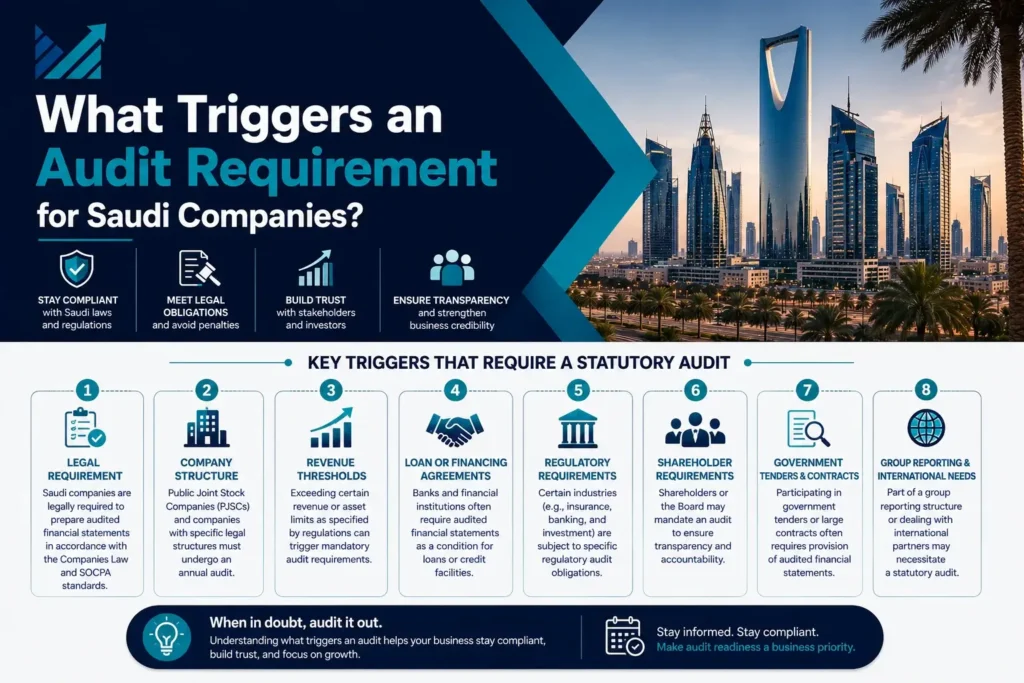
An audit is triggered by legal form (joint stock companies always need one), by size (LLCs above the small or micro thresholds), by foreign ownership, by issuing debt instruments, by a partner’s request, by sector regulation such as banking or insurance, or by a lender, investor, or tender process demanding audited statements.
Trigger 1: Your Legal Form Is a Joint Stock Company
If your company is registered as a joint stock company, whether listed on the Saudi Exchange or closed, the audit requirement is automatic. The Companies Law requires every JSC to appoint one or more SOCPA-licensed auditors, regardless of turnover, assets, or headcount. There is no size exemption available to this legal form.
This trigger cannot be planned around after the fact. It is built into the choice of legal structure at incorporation, so any company considering a JSC structure for future fundraising should treat the audit obligation as a fixed cost of that decision, not a variable one.
Trigger 2: Your LLC Has Grown Past the Small or Micro Threshold
Limited liability companies are generally required to appoint an auditor too, but the Companies Law exempts LLCs that qualify as small or micro. Qualification depends on meeting at least two of the following three tests in the relevant financial year:
- Annual turnover below SAR 10 million
- Total assets below SAR 10 million
- Average employee headcount below 49
This is the trigger that catches growing businesses off guard. A company that opened as a small trading LLC with modest turnover can cross this line within two or three good years, without anyone in finance flagging it as a compliance event rather than a growth milestone. Once the company only meets one of the three tests, the exemption no longer applies, and an auditor must be appointed for that financial year.
Trigger 3: Foreign Ownership Enters the Capital Structure
The small and micro exemption does not apply to companies with foreign ownership, in whole or in part, regardless of turnover, assets, or headcount. A wholly Saudi-owned LLC with SAR 2 million in turnover can be exempt. The same company, after selling a 20 percent stake to an overseas investor, generally cannot rely on the exemption anymore.
This trigger matters most during fundraising conversations. A founder negotiating an investment from a foreign fund should factor the resulting audit obligation into the deal timeline and budget, since it applies from the point foreign ownership is registered, not from the following year.
Trigger 4: The Company Issues or Plans to Issue Debt Instruments
Any LLC that issues debt instruments, such as sukuk or bonds, loses access to the small and micro exemption regardless of its size. Businesses exploring debt capital markets as an alternative to bank financing should treat the audit requirement as part of the cost of that structure, alongside legal and arrangement fees.
Trigger 5: A Partner Holding 10 Percent or More Requests an Audit
Under the Companies Law, partners holding at least 10 percent of an LLC’s capital can require the company to appoint an auditor, even if the company would otherwise qualify for the small or micro exemption. This protects minority partners who want independent assurance over the numbers, and it means majority owners cannot assume the exemption is entirely within their control once outside partners are involved.
Trigger 6: The Articles of Association Require It
Some companies write an auditor appointment requirement directly into their Articles of Association, often at the request of an early investor or as a governance safeguard agreed among founding partners. Once that clause exists, it overrides the size-based exemption regardless of how small the company later becomes. Reviewing the Articles of Association is a useful first step whenever a company is trying to confirm its exemption status.
Trigger 7: The Company Sits Inside a Group Structure
Where an LLC is part of a group, the turnover, assets, and headcount of related entities can be relevant to whether the group as a whole meets the small and micro thresholds. A holding company that looks small in isolation can still be caught once subsidiaries are consolidated into the picture. Businesses restructuring into a group, or adding a new subsidiary, should reassess the audit position at the group level rather than company by company.
Trigger 8: The Business Operates in a Regulated Sector
Banks, insurance companies, finance companies, and other entities licensed by the Saudi Central Bank must be audited as a condition of their licence, independent of the Companies Law size test. Listed companies and CMA-regulated entities, including investment funds and licensed intermediaries, are subject to Capital Market Authority audit and disclosure rules on top of the standard Companies Law obligation. A business expanding into a regulated activity, such as launching a licensed fintech product or an insurance line, should expect the audit requirement to apply from the point the licence is granted.
Trigger 9: The Company Operates a Foreign Branch
A Saudi branch of an overseas company is generally expected to have its local accounts audited, and the parent company’s own reporting obligations can add a further layer of requirements. Companies expanding into the Kingdom through a branch structure, rather than a subsidiary, should confirm the branch-level audit position early, since it is easy to assume the parent’s home-country audit already covers it.
Trigger 10: A Bank, Investor, or Buyer Asks for Audited Statements
Not every trigger comes from the Companies Law. Commercial counterparties routinely require audited financial statements even from companies that are legally exempt. Banks generally ask for them before extending any meaningful credit facility. Investors ask for them, or for a due diligence audit, before committing capital. A buyer in an acquisition will almost always require audited statements, or will commission its own, before closing.
These situations do not carry a legal penalty for non-compliance in the way a Companies Law breach would, but they can stop a deal or a credit facility in its tracks if the company cannot produce audited numbers on the counterparty’s timeline.
Trigger 11: The Company Bids for Government or Large Enterprise Contracts
Government tenders in Saudi Arabia, run through the unified procurement platform under the Government Tenders and Procurement Law, commonly require bidders to demonstrate financial solvency as part of prequalification, and audited financial statements are a standard way to do this for larger contract values. Some large private-sector buyers, including major national companies, apply similar vendor qualification standards. A business planning to bid for public sector or enterprise contracts should check the specific tender’s financial prequalification criteria well before the submission deadline, since producing a first audit under time pressure is far more difficult than planning for it in advance.
Quick Reference: Triggers at a Glance
| Trigger | Applies Regardless of Size? |
|---|---|
| Joint stock company legal form | Yes |
| LLC above small or micro thresholds | This is the size test itself |
| Foreign ownership | Yes |
| Debt instruments issued | Yes |
| Partner holding 10%+ requests audit | Yes |
| Articles of Association requirement | Yes |
| Group consolidation pushes size over threshold | Assessed at group level |
| Regulated sector licence (banking, insurance, CMA) | Yes |
| Foreign branch operations | Generally yes |
| Lender, investor, or buyer request | Commercial, not legal, but effectively unavoidable |
| Government or enterprise tender prequalification | Depends on contract value and buyer |
What If None of These Triggers Apply to You?
A company that is not a joint stock company, meets the small or micro size test, has no foreign ownership, has not issued debt instruments, has no Articles of Association requirement, and operates outside a regulated sector is likely exempt from the statutory audit requirement. That said, exemption is a position to confirm, not assume, especially if the company’s ownership, size, or group structure has changed recently.
It is also worth distinguishing legal exemption from commercial readiness. Plenty of exempt companies still commission a voluntary review or audit because they know a bank or investor conversation is coming, and producing audited numbers on demand is far easier when the company already has a relationship with an auditor.
What to Do Once a Trigger Applies
Once a trigger has been identified, the practical next steps are the same regardless of which one caused it.
Confirm the exact financial year the trigger applies from, since some triggers, like a change in ownership, apply immediately, while others, like crossing a size threshold, apply based on the completed financial year. Appoint a SOCPA-licensed auditor with experience in your industry and company size, and agree the scope and timeline before year-end rather than after it. Gather the supporting records the auditor will need, including reconciled bank accounts, a fixed asset register, and receivable and payable ageing schedules. Build the audit timeline into your reporting calendar so the audited statements are ready for any Ministry of Commerce filing deadline, AGM, or commercial deadline that depends on them.
Frequently Asked Questions
What is the most common trigger that catches growing businesses by surprise?
Crossing the small or micro size threshold as an LLC. Businesses often track revenue growth as a commercial milestone without connecting it to a change in audit status, since the company only needs to fail two of the three size tests to lose the exemption.
Does hiring more staff alone trigger an audit requirement?
Headcount is one of three tests, and a company only loses its exemption once it fails at least two of the three. A company that grows past 49 employees but stays well under the turnover and asset thresholds would generally still qualify for the exemption.
If a foreign investor buys a small stake, does the whole company lose its exemption?
Generally yes. The exemption does not apply to companies with foreign ownership regardless of the percentage held, so even a minority foreign stake removes access to the small and micro exemption.
Can a company that is legally exempt still be asked to produce audited statements?
Yes, regularly. Banks, investors, and buyers can all require audited financial statements as a condition of doing business, independent of whether the Companies Law requires an audit.
Does a group structure always push a small subsidiary into audit territory?
Not always, but it should be checked. Where consolidation is relevant to the size test, a subsidiary that looks small on its own can be caught once the group’s combined turnover, assets, or headcount are taken into account.
How early should a company start preparing once it identifies a trigger?
As early as possible, ideally before the financial year that will be audited closes. Appointing an auditor and organising records in advance shortens the engagement and reduces the risk of missing a filing or commercial deadline.
Summary
The audit requirement for a Saudi company is not a single fixed rule. It is a set of triggers, some built into legal form, some tied to size, ownership, or sector, and some driven by commercial counterparties rather than the law itself. Checking your company against each trigger, rather than relying on the exemption you started with, is the only reliable way to know your current position.
Next Steps
If you are not sure whether a recent change in ownership, size, or structure has triggered an audit requirement for your company, request an audit consultation in Riyadh with our team to review your position before your next filing deadline or tender submission. You can also explore our Saudi audit services to see how a first engagement is scoped for companies in your situation.