

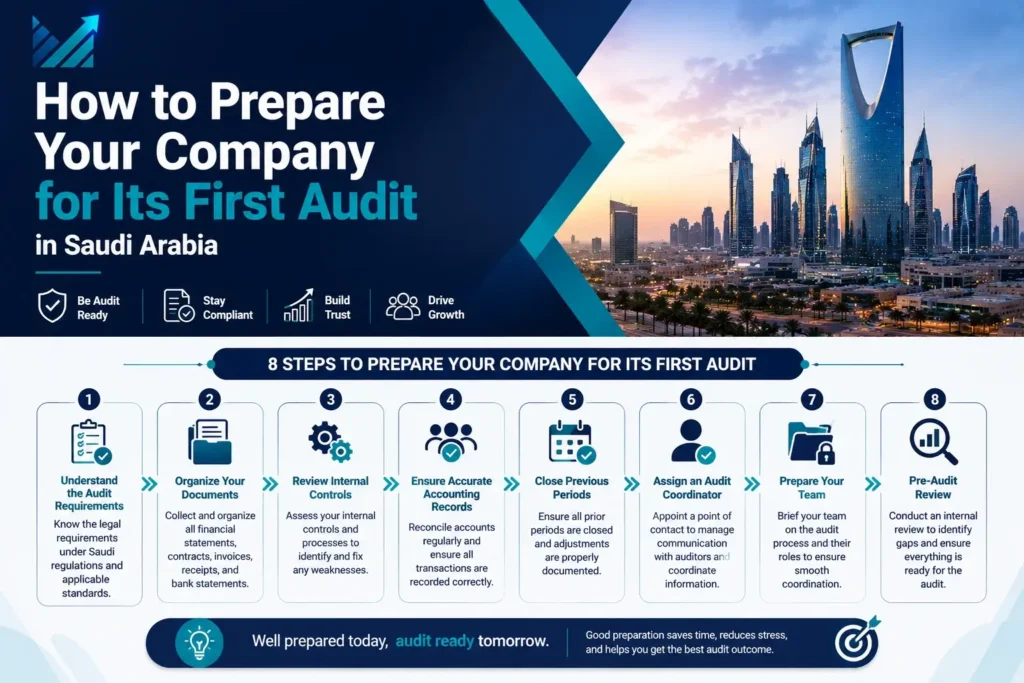
To prepare your company for its first audit in Saudi Arabia, follow a 6-step: audit-readiness framework:
| 1. Align Financial Statements with SOCPA-Endorsed IFRS Standards. |
| 2. Reconcile ZATCA E-Invoicing (FATOORA Phase 2) with Sales Ledgers. |
| 3. Organize Zakat, Corporate Tax, and VAT Returns with Supporting Documents. |
| 4. Validate Payroll Records via the Wages Protection System (WPS) and GOSI. |
| 5. Perform Physical Asset Counts and Bank Reconciliations. |
| 6. Engage an Independent SOCPA-Licensed External Auditor. |
Navigating your company’s first financial audit in the Kingdom of Saudi Arabia (KSA) can feel overwhelming. With Saudi Vision 2030 accelerating digital transformation and regulatory oversight, audit readiness is no longer just an annual administrative task—it is a critical requirement for corporate compliance and business continuity.
Whether you are a foreign company established under a Ministry of Investment (MISA) license, a fast-growing startup in Riyadh, or an SME expanding in Jeddah, understanding how to prepare your company for its first audit in Saudi Arabia ensures seamless compliance, prevents costly penalties, and builds trust with investors and financial institutions.
Benchmark Audit Statistics in Saudi Arabia
To contextualize the regulatory landscape, our data analysis across Saudi business compliance highlights key benchmarks for first-time audit readiness:
- 38% of First-Time Audits Experience Delays: Caused primarily by unverified revenue recognition and missing ZATCA XML e-invoicing clearings.
- 100% Digital Traceability via ZATCA: Over 92% of tax audit inquiries in Saudi Arabia originate from discrepancies between filing returns on the ZATCA portal and general ledger sales accounts.
- Average Audit Preparation Timeline: Companies that conduct a pre-audit dry run reduce final audit completion timelines from 8–10 weeks down to 3 weeks.
First-Time Audit Friction Points in Saudi Arabia (KSA)
+————————————————————-+
| ZATCA E-Invoicing / General Ledger Mismatch [ 42% ] |
| Unreconciled WPS Payroll & GOSI Statements [ 24% ] |
| Non-SOCPA Compliant Revenue Recognition [ 19% ] |
| Missing Physical Inventory / Asset Records [ 15% ] |
Step 1: Align Your Accounting Framework with SOCPA and IFRS
Saudi Arabia mandates that all registered entities prepare their financial statements according to International Financial Reporting Standards (IFRS) as endorsed by the Saudi Organization for Chartered and Professional Accountants (SOCPA).
For your first audit, auditors will verify:
- IFRS for SMEs vs. Full IFRS: Ensure your accounting system uses the correct framework based on your entity’s capital and turnover.
- Proper Chart of Accounts: Ensure assets, liabilities, equity, revenue, and expenses are classified according to SOCPA guidelines.
- Accrual Accounting: Cash-basis accounting is not acceptable for statutory audits in Saudi Arabia. All revenues and expenses must be matched to the accounting period in which they occurred.
Step 2: Ensure 100% ZATCA E-Invoicing & Tax Compliance
The Zakat, Tax and Customs Authority (ZATCA) enforces strict regulations regarding Value Added Tax (VAT), Corporate Income Tax, Zakat, and E-Invoicing (FATOORA). Discrepancies between your internal financial books and ZATCA tax filings are immediate red flags for external auditors.
Audit Checklist for ZATCA Compliance:
- FATOORA Phase 2 Integration: Verify that all B2B and B2C sales invoices are generated in XML/PDF-A-3 format with required QR codes and cryptographic stamps, and cleared/reported through the ZATCA portal.
- VAT Reconciliations: Reconcile your monthly or quarterly VAT returns against your general ledger revenue accounts. Any difference must be documented.
- Withholding Tax (WHT): If your business paid non-resident vendors for legal, software, or consulting services outside KSA, ensure appropriate WHT (5% to 20%) was withheld and remitted to ZATCA.
- Zakat / Tax Calculations: Foreign-owned companies pay Corporate Income Tax (20%), local GCC-owned companies pay Zakat (2.5% on the Zakat base), and mixed-ownership entities pay a proportional mix. Prepare clear supporting worksheets for these calculations.
Step 3: Reconcile WPS Payroll and GOSI Records
Human resources and payroll accounting are heavily scrutinised in Saudi Arabia to ensure compliance with Saudi Labor Law.
Auditors will cross-reference your payroll expenses in the Income Statement against external government portal records:
- Wages Protection System (WPS): Every monthly salary payment must match the bank file submitted via the Ministry of Human Resources and Social Development (MHRSD) WPS portal.
- General Organization for Social Insurance (GOSI): Verify that monthly GOSI contributions for Saudi and expatriate employees match your salary expense accounts and payable ledgers.
- End-of-Service Benefits (EOSB): Ensure that EOSB provisions are accurately calculated according to Saudi Labor Law for all active staff and backed by an actuarial or systematic valuation ledger.
Step 4: Perform Inventory and Fixed Asset Verification
Physical asset and inventory mismatches are among the most common reasons auditors issue qualified or delayed audit opinions.
+————————————————————————————+
| PRE-AUDIT ASSET RECONCILIATION CHECKLIST |
+————————————————————————————+
| [ ] Conduct a physical inventory count on or near the fiscal year-end. |
| [ ] Reconcile physical inventory sheets with inventory software accounts. |
| [ ] Maintain a Fixed Asset Register (FAR) detailing purchase date, cost, location,|
| and SOCPA-compliant depreciation rates. |
| [ ] Record write-offs or disposals with documented management approvals. |
+————————————————————————————+
Step 5: Gather Essential Audit Documentation (The “PBC” List)
Before the audit begins, your external auditor will issue a Provided by Client (PBC) List. Gathering these documents in advance eliminates administrative delays during the audit process.
Primary Master Documents Required:
- Legal Documents: Commercial Registration (CR), MISA License (for foreign entities), Articles of Association (AoA), National Address Certificate, and Chamber of Commerce Membership.
- Bank Statements & Confirmations: Bank statements for all accounts for the entire 12-month period, along with signed bank confirmation letters sent directly to the auditor.
- Major Contracts: Active customer agreements, supplier contracts, property lease agreements (Ejar portal records), and loan agreements.
- General Ledger & Trial Balance: Final, closed Trial Balance, General Ledger, and detailed schedules for all Balance Sheet accounts.
Step 6: Appoint a SOCPA-Licensed External Auditor
Under the Saudi Companies Law, statutory financial audits must be conducted by an independent auditor licensed by SOCPA.
When selecting your auditor:
- Verify their active registration on the SOCPA public portal.
- Ensure they have experience in your industry (e.g., technology, retail, manufacturing, or professional services).
- Schedule a kick-off meeting to clarify timelines, deliverables, and communication protocols before field work begins.
Internal Audit vs. External Audit in Saudi Arabia
To prepare effectively, companies must understand the distinct roles of internal and external audits:
| Feature | Internal Audit | External Audit |
| Primary Objective | Improve operational efficiency, assess internal controls, and detect fraud. | Verify that financial statements present a true and fair view under SOCPA/IFRS rules. |
| Auditor Identity | In-house team or outsourced internal audit consultants. | Independent, SOCPA-licensed accounting firm. |
| Mandate | Management-driven; optional for small entities, mandatory for listed firms. | Mandatory by law for all Limited Liability Companies (LLCs) and Joint Stock Companies in KSA. |
| Primary Recipient | Board of Directors, Audit Committee, or Management. | ZATCA, MISA, Shareholders, Ministry of Commerce, and Banks. |
Connect with our audit team in Riyadh to get started.
Frequently Asked Questions (FAQs)
Is a financial audit mandatory for all companies in Saudi Arabia?
Yes. Under the Saudi Companies Law, all Limited Liability Companies (LLCs), Joint Stock Companies, and branches of foreign companies operating in Saudi Arabia are required to undergo an annual statutory audit by a SOCPA-licensed auditor.
How long does a first-time company audit take in KSA?
For a well-prepared company with reconciled ledgers, an audit typically takes 2 to 4 weeks. However, if accounts are unreconciled or ZATCA and WPS records are missing, the process can take 8 weeks or longer.
What happens if a company fails to submit an audited financial statement in Saudi Arabia?
Failing to submit audited financial statements can lead to fines from the Ministry of Commerce, suspension of your Commercial Registration (CR), penalties from ZATCA, and difficulties renewing MISA licenses or securing bank facilities.
Can a foreign business use an international accounting framework instead of SOCPA?
No. While SOCPA has adopted IFRS standards, all entities registered in Saudi Arabia must comply with IFRS as endorsed in the Kingdom of Saudi Arabia by SOCPA. Adjustments must be made to reflect local tax, Zakat, and legal requirements.