
What does an external audit involve in Saudi Arabia?
An external audit in Saudi Arabia is an independent formal review of a business’s financial records, accounting processes, and internal controls. It ensures compliance with International Financial Reporting Standards (IFRS) as endorsed by the Saudi Organization for Chartered and Professional Accountants (SOCPA) and the Saudi Companies Law (Royal Decree No. M/132).
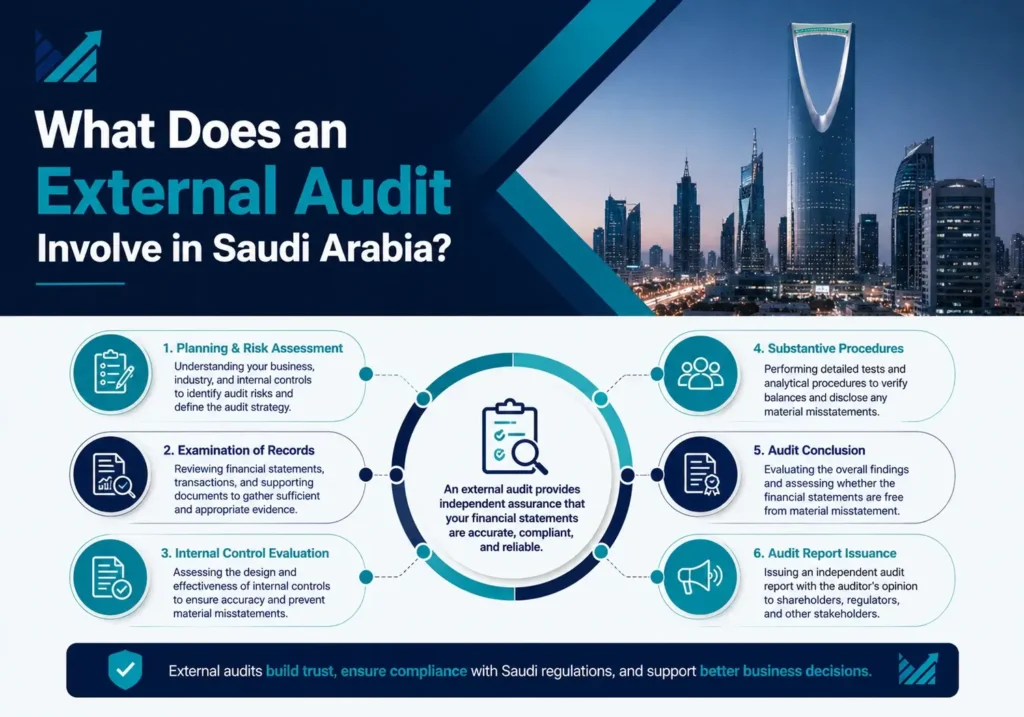
The external audit process involves five main stages:
- Engagement & Planning: Establishing scope, risk assessment, and audit strategy.
- Internal Control Evaluation: Testing accounting systems and risk prevention protocols.
- Substantive Fieldwork: Verifying transaction samples, balances, contracts, and assets.
- Tax & Regulatory Alignment: Verifying compliance with ZATCA (Zakat, Tax, and Customs Authority).
- Reporting & Opinion: Issuing an independent Auditor’s Report with financial statements submitted via the Qawaem platform.
External Auditing in Saudi Arabia’s Modern Business Ecosystem
As the Kingdom of Saudi Arabia accelerates its economic transformation under Vision 2030, corporate governance, financial transparency, and regulatory compliance have taken center stage. Operating a business in Saudi Arabia—whether a foreign entity under MISA (Ministry of Investment), a local Limited Liability Company (LLC), or a publicly traded entity on the Tadawul—requires strict adherence to statutory financial audit guidelines.
Understanding what an external audit involves in Saudi Arabia is essential for business owners, CFOs, board members, and regional managers operating across the GCC. An external audit is not merely a legal obligation; it is a strategic mechanism that establishes market credibility, mitigates corporate risk, and safeguards stakeholder interests.
Regulatory & Legal Framework Governing External Audits in KSA
External audits in Saudi Arabia operate under a rigorous, multi-tiered legal framework enforced by several government entities:
+———————————–+
| Saudi Ministry of Commerce |
+—————–+—————–+
|
+———————–+———————–+
| |
+———–v———–+ +———–v———–+
| SOCPA Oversight | | ZATCA Compliance |
| (IFRS Endorsement & | | (Zakat, Corporate Tax |
| Auditor Licensing) | | & E-Invoicing / |
+———–+———–+ | Fatoora) |
| +———————–+
+———————–+
|
+———–v———–+
| Qawaem Platform |
| (Mandatory Financial |
| Statement Deposit) |
+———————–+
Key Governing Laws & Oversight Bodies:
- Saudi Organization for Chartered and Professional Accountants (SOCPA): Operates under the Ministry of Commerce to endorse International Financial Reporting Standards (IFRS) and International Standards on Auditing (ISA) tailored with local regulatory modifications.
- New KSA Companies Law (Royal Decree No. M/132): Mandates annual statutory external audits for specific corporate structures and defines director liability and financial filing deadlines.
- Zakat, Tax and Customs Authority (ZATCA): Requires audited financial reports to validate Zakat and Income Tax assessments for both local and foreign-owned entities.
- Capital Market Authority (CMA) & SAMA: Provide heightened audit compliance guidelines for publicly listed entities, financial institutions, and insurance sectors.
Mandatory vs. Exempt Entities in Saudi Arabia
Not every commercial register in Saudi Arabia carries identical audit mandates. Below is a structural breakdown of audit obligations by entity type:
| Entity Type | External Audit Required? | Primary Governing Authority | Key Regulatory Requirement |
| Public Joint Stock (Tadawul) | Mandatory | CMA & SOCPA | Full IFRS; Quarterly & Annual Audited Reports |
| Limited Liability Company (LLC) | Mandatory | Ministry of Commerce | Annual Audited Statements uploaded to Qawaem |
| Foreign Company Branch | Mandatory | MISA / Ministry of Commerce | Annual Compliance & ZATCA reconciliation |
| Sole Proprietorship (Establishment) | Conditional | Ministry of Commerce / ZATCA | Required if revenue exceeds statutory VAT/Zakat thresholds |
| Financial Institutions & Banks | Mandatory | SAMA | Full IFRS & Specialized Industry Standards |
The 5 Key Stages of an External Audit Process
[1. Planning & Scope] ──► [2. Internal Control Evaluation] ──► [3. Substantive Testing] ──► [4. Tax & ZATCA Review] ──► [5. Opinion & Qawaem Filing]
Stage 1: Engagement, Planning, and Risk Assessment
The external auditor issues an Audit Engagement Letter defining scope, responsibilities, and timelines. During this phase, the audit team conducts a comprehensive risk assessment of the business environment, accounting systems, and key operational areas.
Stage 2: Internal Control & Governance Evaluation
Auditors review internal control structures to evaluate risk of error or fraud. They assess:
- Segregation of accounting duties.
- Authorization levels for capital expenditure.
- Data security and IT general controls (ITGC) across ERP software (e.g., SAP, Oracle, Zoho).
Stage 3: Substantive Testing & Fieldwork
During fieldwork, auditors collect third-party evidence to verify financial assertions:
- Asset Verification: Physical inventory counts and fixed asset inspections.
- Bank Confirmations: Independent third-party confirmation of cash balances and credit lines.
- Receivables & Payables: Circularization of key supplier and client balances.
- Revenue Recognition: Verifying compliance with IFRS 15 revenue recognition models.
Stage 4: ZATCA Tax & Zakat Alignment Review
External auditors verify that book entries align with Saudi Arabia’s tax rules:
- Reconciliation of commercial net income with Zakat taxable base.
- Cross-checking Phase 2 E-Invoicing (Fatoora) integration and VAT filings against general ledger balances.
Stage 5: Reporting, Management Letter, and Qawaem Filing
The auditor drafts the final Auditor’s Report. Along with the financial statements, management receives a Management Letter outlining identified internal control weaknesses and recommendations. Upon board approval, the final audited statements are submitted through the Qawaem digital portal.
Benchmarking & Data Insights: Audit Operations in Saudi Arabia
To provide context for financial managers and business owners, recent corporate governance metrics highlight operational standards in KSA:
Average External Audit Engagement Timeline in KSA:
┌───────────────────────────┬──────────────────────────────────────┐
│ Stage │ Duration │
├───────────────────────────┼──────────────────────────────────────┤
│ Planning & Engagement │ 1 – 2 Weeks │
│ Fieldwork & Testing │ 2 – 4 Weeks │
│ Draft & Review │ 1 – 2 Weeks │
│ Final Sign-off & Filing │ 1 Week │
└───────────────────────────┴──────────────────────────────────────┘
Total Average Duration: 5 – 9 Weeks
- IFRS Accounting Adoption Rate: 100% of publicly accountable entities and medium-to-large businesses operate under SOCPA-endorsed IFRS standards.
- Digital Integration Rate: Over 94% of audited financial statement submissions in Saudi Arabia are now filed digitally via the Ministry of Commerce’s Qawaem platform.
- Primary Compliance Focus Areas: Audit findings in Saudi Arabia predominantly relate to IFRS 15 (Revenue Recognition), IFRS 16 (Lease Accounting), and ZATCA Phase 2 E-Invoicing compliance.
Audit Opinions Explained
Upon completing the audit, the external auditor issues one of four standard opinion types:
+———————–+
| Auditor’s Evaluation |
+———–+———–+
|
+——————+————–+————–+——————+
| | | |
+——-v——-+ +——-v——-+ +——-v——-+ +——-v——-+
| Unqualified | | Qualified | | Adverse | | Disclaimer of |
| (Clean) | | (Except For) | | (Material | | Opinion |
| Statements | | Minor Issues | | Error/Misstate| | (Insufficient |
| are fair | | noted | | present) | | Evidence) |
+—————+ +—————+ +—————+ +—————+
- Unqualified Opinion (Clean): Financial statements present fairly, in all material respects, the financial position of the company in compliance with SOCPA/IFRS standards.
- Qualified Opinion: Financial statements are generally reliable, except for a specific material departure or limitation in audit scope.
- Adverse Opinion: Financial statements are materially misstated and do not give a true and fair view of the company’s financial health.
- Disclaimer of Opinion: The auditor was unable to obtain sufficient audit evidence to form an opinion (e.g., destroyed records or restricted access).
Strategic Checklist: Preparing for an External Audit in KSA
To minimize audit friction and ensure compliance, finance teams should prepare the following documents prior to auditor onboarding:
- [ ] Trial Balance & General Ledger: Complete trial balance reconciled through year-end.
- [ ] SOCPA & IFRS Adjustments: Documented schedules for asset depreciation, provisions, and statutory reserves.
- [ ] ZATCA Reconciliation Files: Reconciled VAT statements, WHT (Withholding Tax) returns, and Zakat base calculations.
- [ ] Bank Confirmations & Reconciliations: Certified balance statements from all active financial accounts.
- [ ] Fixed Asset Register: Updated list detailing additions, disposals, and impairment tests.
- [ ] Legal & Corporate Governance Records: Board meeting minutes, commercial registration (CR) renewals, and articles of association.
Get help from best audit firm in Jeddah
Frequently Asked Questions (FAQ)
What is the difference between an internal audit and an external audit in Saudi Arabia?
An internal audit is an ongoing advisory function conducted by internal staff or outsourced consultants to evaluate internal controls, risk management, and operational efficiency. An external audit is an independent financial review conducted annually by a licensed SOCPA auditor to provide third-party assurance to regulators, shareholders, and lenders.
Who is authorized to perform an external audit in Saudi Arabia?
Only audit firms registered and licensed by SOCPA (Saudi Organization for Chartered and Professional Accountants) under the Law of the Profession of Accounting and Auditing can perform statutory external audits in KSA.
What is Qawaem, and how does it relate to external audits?
Qawaem is the electronic platform managed by the Ministry of Commerce in Saudi Arabia. External auditors upload certified financial statements directly to Qawaem, allowing government authorities (including ZATCA and the Ministry of Commerce) to access validated corporate financial reports.
What are the consequences of failing to complete an external audit in KSA?
Failure to submit audited financial statements within prescribed statutory deadlines (typically within 3 to 4 months of fiscal year-end under the New Companies Law) can result in financial penalties from the Ministry of Commerce, suspension of Commercial Registration (CR) services, and ZATCA assessment delays.